Priority updates
Encourage and help MITEI’s members to fund more energy research with MIT faculty
In FY25, MITEI raised more than $30 million in multi-year commitments from new and renewing members. This funding supports MIT researchers in advancing MITEI’s mission of accelerating the energy transitionand also sponsors research by undergraduate and graduate students and postdocs. Our Member Relations team actively seeks to grow research funding by bringing in new members, and by working closely with existing members to conceive and execute new research projects MITEI has a regular process of engagement with its corporate members. Through facilitated meetings with faculty, scheduled events covering many technologies, and customized workshops involving teams of MIT principal investigators (PIs), MITEI discovers topics of interest to its members and identifies opportunities for substantive collaborations with MIT researchers. Research takes the form of both sponsored projects by individual companies and jointly sponsored activities in areas of mutual member interest. Leveraging MITEI’s existing administrative infrastructure, we are able to quickly initiate new projects with researchers across the MIT campus when we find a match between capabilities and member interest. Where we identify new strategic areas of focus, we build the collaborative foundation for future work in critical areas such as data center power, low-carbon fuels, and long-duration energy storage.
Address the data center problem
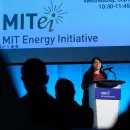
In 2023, data centers consumed about 4.4% of the total electricity supply in the United States. With the burgeoning number of data centers, the demand for energy is projected to far exceed the power supply in the future. The growing energy demand from data centers was one challenge MITEI recognized when we identified the theme for our 2024 Annual Research Conference as, “A durable energy transition: How to stay on track in the face of increasing demand and unpredictable obstacles.” A panel discussion with key stakeholders examined this topic more deeply at the MITEI fall conference. The 2025 Spring Symposium, “AI and energy: Peril and promise,” continued that exploration by looking at the key challenges and opportunities at the nexus of AI and energy. For broader audiences and to help inform the public on this urgent issue, we also published an article highlighting the data center/energy challenge and a brief video featuring MITEI Director William H. Green explaining the issues we currently face.
In FY25, MITEI began exploring the launch of a members’ interest group focused on the urgent energy needs arising from the rapidly growing demand for electricity for data centers. The Data Center Power Forum, launched in early FY26, is leveraging MITEI’s established expertise and leadership in convening multiple energy sectors to consider a timely and complex issue facing many companies.
Organize better assessments of new energy technologies
The true potential of new technologies to address energy and climate challenges is too often obscured by inconsistent approaches, assumptions, or valuations within techno-economic analyses and lifecycle assessments. This failure erodes trust and undermines promising technologies in the eyes of investors, policy makers, and the public. In collaboration with the MIT Climate Project, MITEI is committed to defining best practices and standards for assessing the technical and economic viability and evaluating the climate benefits of new energy technologies. This is critical to empowering stakeholders to make clear, data-backed decisions about the new technologies meriting support. We have recruited renowned researchers in techno-economic and emissions assessment to serve on a steering committee. The first meeting was held in early June 2025. Under the leadership of MITEI Director William H. Green, and Elsa Olivetti, the Jerry McAfee Professor in Engineering, the goal of the Consistent Lifecycle and Economic Assessment Recommendations (CLEAR) effort is to develop state-of-the-art assessment approaches that can produce reliable, robust results grounded in trusted principles and data.