MITEI leads energy education at MIT and has engaged thousands of students, preparing the next generation of innovators, entrepreneurs, and policy makers to accelerate solutions to global energy challenges.
Priority update
Make a plan to revitalize energy education at MIT
In preparing the Energy Studies Minor’s five-year report to the Committee on Curricula, MITEI Education broadly evaluated opportunities to evolve its energy education program and engage more students over the next five years. The MIT Committee on Curricula responded with a letter that commended MITEI’s effort and dedication and said the “Energy Studies Minor is clearly a cohesive and valuable program.”
MITEI leads MIT’s energy education efforts and has engaged with thousands of students through sponsored research opportunities and other programs—preparing the next generation of innovators, entrepreneurs, and policy makers to collaborate on solutions to global energy challenges. Energy education programs include the Energy Studies Minor, Undergraduate Research Opportunities Program in energy, short modules during the Independent Activities Period, an energy-focused first-year pre-orientation program, the postgraduate Society of Energy Scholars, and online energy classes open to a global audience. Faculty associated with MITEI help shape energy education at both the undergraduate and graduate levels by teaching, advising, and developing new curricula.

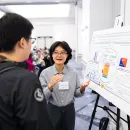
At MITEI’s 2024 Annual Research Conference, Energy UROP students presented their research to MITEI’s corporate members and conference attendees during poster sessions. Photo: Jake Belcher
Education highlights
Energy Studies Minor
MITEI supports and regularly updates the Energy Studies Minor curriculum, relying on an endowed fund provided by a generous donor. The Energy Studies Minor enables undergraduate MIT students to gain an integrative understanding of energy and develop the skills required of tomorrow’s energy professionals, leaders, and innovators in research, industry, policy, management, and governance. 216 students have graduated with the Energy Studies Minor, including four that graduated in 2025. Eight are on track to graduate with the minor in 2026. The new Chair of the Energy Minor Oversight Committee, Professor Daniel Frey (Mechanical Engineering), worked with the committee to evaluate course development proposals that MITEI then funded to refresh the Energy Minor Curriculum. A particular goal is enhancing connections between the energy minor and computer science, including promising applications of AI/machine learning for analyzing and solving energy challenges. Increasingly, we are also coordinating with other energy/climate/sustainability offerings at MIT to enhance efficiency and to be complementary in the curriculum, to engage students, and to link with Climate Project initiatives as those take shape.
Teaching Assistant support
MITEI provided support for graduate teaching assistants in the following subjects: 1.067[J]: Energy Systems for Climate Change Mitigation, 5.812[J]: Principles of Innovation, EC.711: Introduction to Energy in Global Development, and EC.712[J]: Applications of Energy in GlobalD MITEI also provided course development funds for 8.01x: Information and Entropy: Energy and Exergy.
Postgraduate Scholars
In 2024–2025, MITEI welcomed 14 new graduate students and postdocs to the Society of Energy Scholars (formerly known as the Society of Energy Fellows). The Energy Scholars network at the end of FY25 totaled more than 540 current and former graduate students and postdoctoral fellows, spanning 20 departments and divisions at MIT’s five schools and one college. In FY25, support was provided by MITEI member companies Shell, Chevron, Eni S.p.A., and ExxonMobil, and by Friends of MITEI.

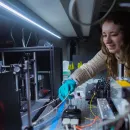
During summer 2024, 24 students conducted energy research through MITEI’s Energy Undergraduate Research Opportunities Program. Photo: A. Laiman – MIT Technique
Undergraduate energy research
During FY25, MITEI supported 85 Undergraduate Research Opportunities Program (UROP) student projects, bringing the total UROPs supported by MITEI since inception to 1,060.
Online energy courses
To train global professionals, policy makers, and students in energy topics and tools to support and accelerate the energy transition, the MITEI education team has developed a series of open online courses (MOOCs) based on interdisciplinary residential MIT subjects. These courses are free and available in almost every country, and have attracted more than 145,000 online learners. The courses cover critical aspects of future energy systems: load and demand-side management; economics and regulation; production, distribution, and transmission; mobility; and integrating climate topics across disciplines. The courses include Sustainable Building Design; Sustainable Energy; Energy Economics and Policy; Transformative Living Labs in Mobility; and Climate in Classrooms: Tools for All Teachers and Disciplines.
IAP courses
MITEI supported several IAP courses in January 2025. “Information and Entropy: Energy and Exergy” focused on the concept of entropy and its connection to information theory, as well as ideas about exergy and the usefulness of energy, energy efficiency, and CO2. “AI for Energy Solutions” (47-210 attendees, depending on the lecture), which explored the applications of AI/machine learning to climate and energy challenges, and was offered to MIT and participants out of MIT via Zoom. “Computational Modeling for Clean, Reliable, and Affordable Electricity” offered a hands-on learning experience introducing analysis techniques to model and understand the role of electric power systems within a carbon-constrained economy, for which 49 students enrolled.

Six MIT students got a first-hand view of the energy industry in Denmark as part of a field trip in August 2024. With support from the MIT Energy Initiative, they visited startups working on safer nuclear energy production; local utility companies integrating offshore wind, biowaste, and district heating; a green-energy-based business park; and more.
First-Year Pre-Orientation Program (FPOP)
MITEI’s summer 2024 energy pre-orientation program welcomed 18 new first-year students to the MIT community. Activities included a visit to a sustainable farm, tours of MIT’s Nuclear Reactor Lab and the Plasma Science and Fusion Center, and talks with faculty and student group leaders.
Field trip to Europe
In August 2024, MITEI Education Director Antje Danielson took six undergraduate and graduate students to Denmark to explore renewable energy startups and visit the Danish Tech University in Copenhagen.
Support for student groups
MITEI provides financial and staff support for a number of student groups throughout the year. In FY25, these included the MIT Energy and Climate Club, MIT Solar Vehicle Team, MIT Motorsports, MIT Wind, the MIT Sustainable Engine Group, the MIT TPP Policy Hackathon, and the MIT Energy and Climate Hackathon.