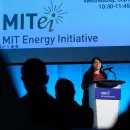
MITEI's commitment to advancing low- and zero-carbon solutions has never been stronger—and the urgency has never been greater.
Letter from the director

William H. Green
As I complete 18 months as director of the MIT Energy Initiative (MITEI) and look forward to MITEI’s 20th anniversary next year, I am excited about the publication of our Fiscal Year 2025 Annual Impact Report. The report demonstrates that MITEI is on solid footing, with healthy membership numbers, major new research initiatives, and increased campus engagement. MITEI remains more committed than ever to advancing low- and zero-carbon solutions for the energy transition, with the goals of increasing energy access, ensuring reliable, clean, and affordable energy, and mitigating greenhouse gas emissions.
In our conversations over the past year, MIT Vice President for Research Ian Waitz, who oversees MITEI and MIT units like the Plasma Science and Fusion Center, MIT.nano, and the Technology Licensing Office, has reinforced the strong support MITEI has from the Institute. MIT’s senior leadership recognizes MITEI’s success in supporting energy transition research and innovation across campus, sustaining funding for graduate students and undergraduate research, convening important energy events, and producing highly respected and rigorous reports on emerging energy technologies.

MITEI completed Fiscal Year 2025 (FY25) with a fully staffed leadership team. Carolyn Ruppel (SB, SM ’86, PhD ’92), who has had a long research career in energy and climate, most recently at the U.S. Geological Survey and earlier on the faculty at Georgia Tech, joined MITEI in March as the deputy director of science and technology. We were also fortunate to recruit Morgan Andreae (PhD ’06), formerly executive director for technology and innovation at Cummins, to become executive director of MITEI’s Future Energy Systems Center consortium.
Shifting priorities for external energy funding have posed challenges for MIT researchers this year, but MITEI’s industry-sponsored model has proved resilient. MITEI had 38 member companies in FY25, and our roster of already-renewed Founding and Sustaining memberships will ensure stable sponsored funding for MIT’s energy transition research for the next few years. MITEI is working with several current and prospective member companies that have expressed interest in enhanced energy research portfolios at MIT. MITEI member agreements are increasingly enabling companies to engage more broadly with MIT through involvement in other research consortia or a wider range of sponsored research topics.
At the close of FY25, MITEI prepared several initiatives for imminent launch. The Data Center Power Forum offers our members access to the combined expertise of MITEI and Sloan School’s Center for Energy and Environmental Policy Research (CEEPR) on topics such as data center energy supply and storage, grid design and management, infrastructure, and regulatory and economic policy. The Forum builds on ~20 already-funded MITEI projects in these areas and complements MIT’s expertise in quantum computing, low-energy electronics, photonics, efficient algorithms, and the societal consequences of data center expansion. In early 2026 MITEI will launch a two-year study on the Future of Fuels for aviation and long-distance trucking, shipping, and rail, with myself as the study director, MITEI’s Director of Research Randall Field as executive director, and experts from across MIT as contributors. The study, whose advisory board is open to both MITEI members and non-members, will evaluate alternative liquid fuels that can be directly substituted for fossil fuels in existing engines and infrastructure. This examination of biofuels and e-fuels will consider regional differences in feedstock availability, markets, and regulatory frameworks.
In addition, the Future Energy Systems Center has established for its members a focused interest group and advisory board on long-duration energy storage, forging a new research model that will be adaptable to other high-priority energy topics. The topic of long-duration energy storage has proved to be of interest to MITEI members from a variety of sectors, including energy, power, heavy industry, and infrastructure. MITEI has also initiated an effort called CLEAR (Consistent Lifecycle and Economic Assessment Recommendations) that both MITEI member companies and others may support. CLEAR is co-led by myself and Professor Elsa Olivetti (DMSE and the Climate Project) and involves an international group of experts as a steering committee. CLEAR teams are establishing best practices for techno-economic analyses and lifecycle assessments of energy technologies and formulating educational materials to train the next generation of energy analysts for industry and academia.
MITEI continues to have an outsized impact at MIT and beyond. In April, MITEI partnered with MIT Sloan School’s Climate Policy Center and the MIT Washington Office to co-host the multi-day Senior Congressional Staff Seminar, which was attended by a bipartisan group of 27 staffers. The FY25 MITEI Presents: Advancing the Energy Transition seminars hosted such luminaries as the leader of the U.S. Energy Information Administration and the presidents and CEOs of the Natural Resources Defense Council and of the Engine, MIT’s nonprofit incubator and tough-tech accelerator. MITEI’s 2025 Spring Symposium, “AI and energy: Peril and promise,” explored how AI is accelerating the energy transition while also dramatically increasing energy demand. And MITEI’s newly launched energy transition podcast, “What if it works?” attained more than 1,000 subscribers in its first year.
MITEI’s education programs extend our reach across MIT and to the global community. To support undergraduate energy education and training, MITEI manages the integrative Energy Studies Minor, sponsors faculty to develop new energy courses, and funds teaching assistants and IAP short courses. Since its inception, MITEI has sponsored more than 1,000 energy UROP projects, including 85 in FY25. About 1,700 graduate students have been supported on MITEI projects since 2006, with more than 540 named as Energy Scholars. Energy Scholar alumni serve in technical and executive positions at established companies as well as MIT energy startups. Some of the most successful of these startups were in turn spawned by inventions originating as MITEI seed grants. Through our online open learning courses, MIT’s energy expertise reaches the world, with over 26,700 students enrolled in FY25.
As we commence planning for MITEI’s 20th anniversary, MITEI is honored to be recognized for its key role in sustaining energy transition research and education at MIT. We are proud of the achievements described in this FY25 impact report and look forward to continuing to support the MIT energy community through grants from the Future Energy Systems Center and seed funds, sponsored research, the Energy Scholar and UROP programs, and other initiatives.
Sincerely,
William H. Green
Director, MIT Energy Initiative
Hoyt C. Hottel Professor of Chemical Engineering