MITEI raised more than $53 million in the 2024 fiscal year (FY24), with the primary objective of decarbonizing the global economy with zero- and low-carbon technologies and integrated energy systems supported by effective policy. The funding amount is the sum of multi-year commitments made in FY24 from new and renewing members. Research projects launched by MITEI in FY24 totaled $16.8 million. The areas that garnered the most new research support this year were basic energy science at $7.45 million and power distribution and energy storage at $5.2 million. The balance of this year’s research funding was allocated to support a range of other energy topics, including renewable energy, policy and economics, and built environment and infrastructure.
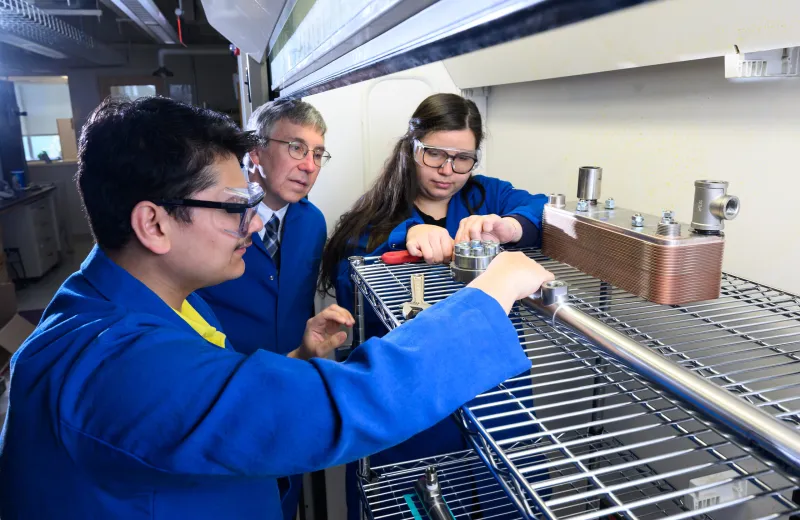
MIT researchers are exploring a promising plan to use clean-burning hydrogen in place of the diesel fuel now used in most freight-transport trucks—a change that would significantly reduce their greenhouse gas emissions. Photo: Gretchen Ertl
With support from its Members, as well as numerous foundations, donors, various government entities (state and federal), and university partners, MITEI has supported more than 1,050 projects through FY24. MITEI’s work is guided by the use of advanced system modeling and analysis techniques to understand the climate as well as financial, economic, and social impacts of available pathways against the complex backdrop of the energy system as a whole.
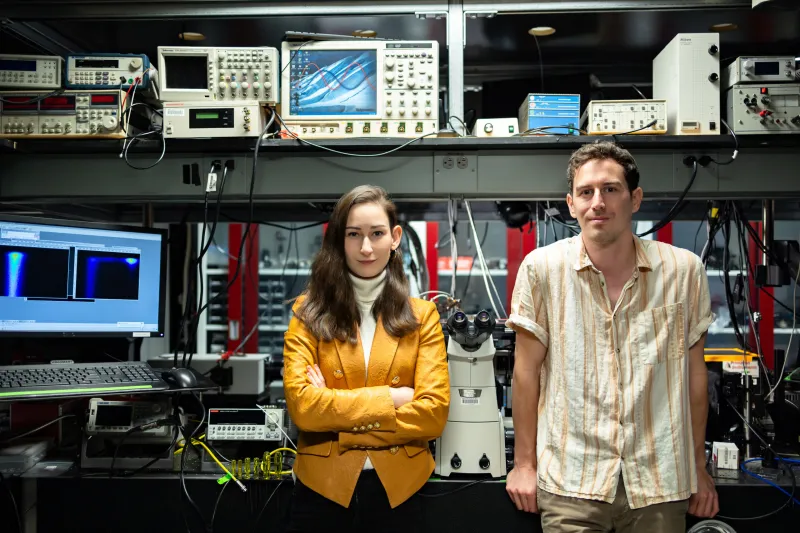
A team of MIT researchers and researchers from several other institutions has revealed ways to optimize efficiency and better control degradation by engineering the nanoscale structure of perovskite devices. Team members include Madeleine Laitz, left, and lead author Dane deQuilettes. Photo courtesy of the researchers.
Research program highlights
- The Future Energy Systems Center: The Future Energy Systems Center , which examines the accelerating energy transition as technologies, policies, demographics, and economics impact energy supply and demand, awarded $4.15 million to support 22 new projects. The Center is now carrying out 43 system modeling and analysis projects. The topics range from the hurdles of small modular reactors for industrial settings to the interplay between H2 production and renewable fuel synthesis. MITEI kicked off meetings for each of these new projects at the Center’s November 2024 Workshop.
- Future Energy Systems Center meetings and workshops: In May, the Future Energy Systems Center held its spring workshop to address pressing topics, including the role of bioenergy in the energy transition, decarbonizing buildings in cold climates, and the potential for nuclear power to play a significant role in the energy transition. It also held its advisory committee meeting and a student presentation and poster session.
- Future Energy Systems Center webinars: This series of webinars has provided an opportunity to share information about emerging technologies, policies, and sustainability issues from MIT professors across departments. The webinars also provide a venue for sharing the latest updates on the Center-supported projects.
- Funding for early-stage research: In FY24, MITEI funded six early-stage research projects for a total of $900,000, through the MITEI Seed Fund. MITEI has supported more than 220 energy-focused seed projects with grants totaling more than $28.8 million.
- Systems modeling tools: MITEI’s internal research team has made substantial progress toward further developing a unique and powerful set of energy system analysis and optimization tools. The Sustainable Energy System Analysis Modeling Environment (SESAME), a web application incorporating a growing number of features and capabilities for modeling energy system emissions and cost scenarios, is being used and expanded in projects funded by the Future Energy Systems Center and by industry. In 2023, the climate tech software startup Sesame Sustainability was spun out of MITEI, leveraging SESAME’s unique platform for technoeconomic and life cycle analysis to accurately evaluate industrial decarbonization solutions at scale. GenX, our state-of-the-art electricity system capacity expansion model for investment planning in the power sector, is being used in a number of Future Energy Systems Center projects, and by researchers and companies around the world. GenX was released as an open-source tool in 2021. A multi-sector expansion of the GenX model released as an open-source tool in 2022, the Decision Optimization of Low-carbon Power-HYdrogen Network (DOLPHYN), was used to inform multiple high-impact articles published in journals such as Nature Energy and Nature Communications.