MITEI supported 48 students through the Undergraduate Research Opportunities Program, welcomed 9 new graduate students and postdocs to the Society of Energy Fellows, and enabled 35 students to go on three field trips in 2023-2024, all as part of MITEI’s role as an educator of future energy change agents. MITEI’s educational efforts are critical to its mission as a catalyst for tomorrow’s low-carbon energy solutions. Through its various programs, MITEI provides a robust educational toolkit to MIT graduate and undergraduate students, global online learners, and high school students who want to contribute to the energy transition.
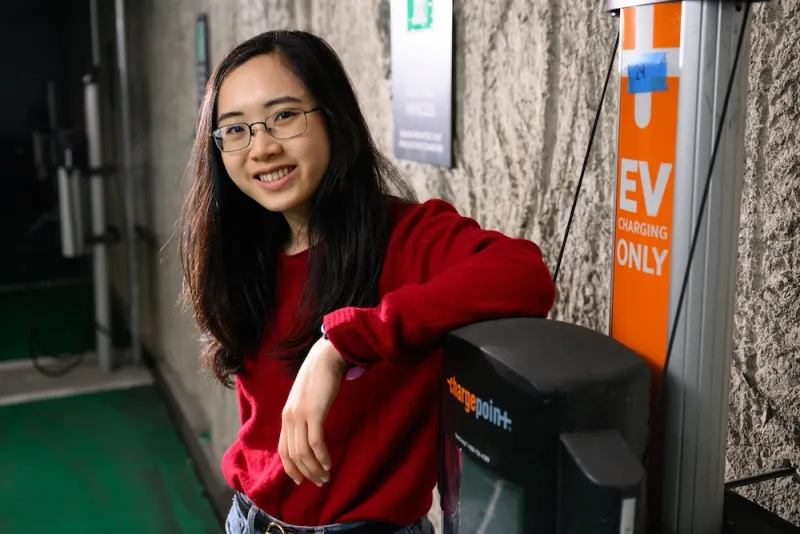
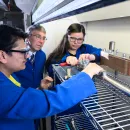
With a double major in mathematics and electrical engineering and computer science, MIT senior Elaine Siyu Liu is exploring the ways in which renewable energy and electric vehicles impact the power grid. Photo: Gretchen Ert
These programs enable students to take classes; conduct research in diverse areas, from energy science and social science to technology and engineering; practice their skills; become leaders; and network with peers and professionals. MITEI’s education team serves on various climate-related committees to shape the Institute’s climate response and work with MIT faculty members to develop curricula and act as advisors to aspiring and current energy students.
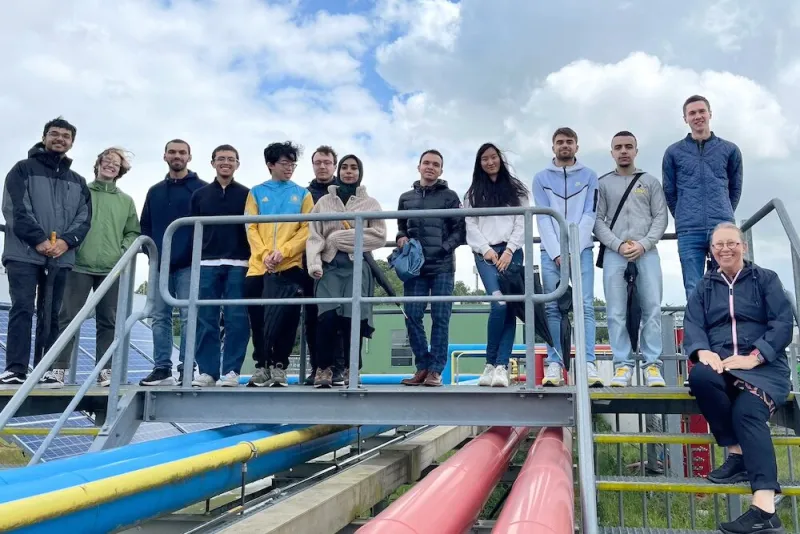
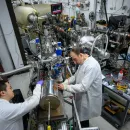
As part of a MITEI-sponsored field trip to the Netherlands to experience the country’s approach to sustainable energy, students received a tour of EnTranCe, a facility dedicated to researching hydrogen usage within the energy grid, at Hanze University in Groningen. Photo courtesy of MITEI.
Education program highlights
- Graduate Fellows: With the 9 new graduate students and postdocs MITEI welcomed to the Society of Energy Fellows in 2023-2024, the Energy Fellows network now totals more than 560 current and former graduate students and postdoctoral fellows, spanning 20 departments and divisions at MIT’s five schools and college. This year’s fellowships were supported by MITEI member companies Chevron, Eni, ExxonMobil, and Shell.
- Collaboration with GradEL: During the spring semester, in weekly interactive sessions, 14 graduate students from across campus were challenged to clarify how their work has potential impact and how best to communicate this. MITEI Education Director Antje Danielson co-taught the class 6.S640, “How will my research matter? Optimizing projects towards impact,” as part of the Riccio Graduate Engineering Leadership Program (GradEL). 100% of the survey respondents agreed that they are better able to talk about their research to different audiences after taking the class.
- Energy Systems Team Practicum: MITEI piloted the first team practicum at Shell TechWorks in Boston during IAP 2024. For one month, 14 MIT graduate students and postdocs from 10 disciplines worked on four climate- and energy-related projects, relevant to Shell’s future energy portfolio. They were supervised by MITEI and Shell staff with input from MIT faculty and researchers.
- Online energy courses: To train global professionals, policy makers, and students in research methods and tools to support and accelerate the energy transition, the MITEI education team has developed a series of open online courses (MOOCs) based on interdisciplinary residential MIT subjects. These courses are free and available in almost every country and have attracted more than 115,000 students. They engage critical aspects of future energy systems: load and demand-side management; economics and regulation; production, distribution, and transmission; and mobility. The courses include Sustainable Building Design; Sustainable Energy; Principles of Modeling, Simulation, and Control for Electric Energy Systems; Energy Economics and Policy; and Transformative Living Labs in Mobility.
- IAP courses: MITEI offered two IAP courses in January 2024. “Leading the Energy Transition” invites energy leaders to share their strategies in accelerating the change to a net-zero carbon world. “Computational modeling for clean, reliable, and affordable electricity” offers a hands-on learning experience introducing analysis techniques to model and understand the role of electric power systems within a carbon-constrained economy.
- First-Year Pre-Orientation Program: MITEI’s summer 2023 energy pre-orientation program welcomed 19 new first-year students to the MIT community. Activities included a visit to a wind turbine testing facility, tours of MIT’s Nuclear Reactor Lab and the Plasma Science and Fusion Center, a visit to a nearby sustainable farm, and sailing on the Charles (the original wind energy!).
- Energy Studies Minor: The Energy Studies Minor allows undergraduate MIT students to gain an integrative understanding of energy and develop the skills required of tomorrow’s energy professionals, leaders, and innovators in research, industry, policy, management, and governance. Over 200 students have graduated with the Energy Studies Minor, including 12 graduated in 2024.
- Undergraduate energy research: MITEI supported 48 student projects through the MITEI Undergraduate Research Opportunities Program during the 2023-2024 academic year, bringing its total of sponsored projects to 975.
- Field trips to Europe: In August 2023, MITEI Education Director Antje Danielson took 9 undergraduate and graduate students to Denmark to explore renewable energy startups and visit the Danish Tech University in Copenhagen. In June 2024, she took 7 students to the Netherlands, visiting the Ports of Eemshaven and Rotterdam, Hanze University of Applied Science’s Center of Expertise Energy, Groningen University, and a number of companies involved in offshore wind and hydrogen production.
- Support for student groups: MITEI provides financial and staff support for a number of student groups throughout the year. In FY24, these included the MIT Solar Vehicle Team, Electric Vehicle Team, StartLabs, SPOKES, MIT Motorsports, the MIT TPP Policy Hackathon, and the MIT Energy and Climate Hack.
- High school curriculum: MITEI Deputy Director for Policy Christopher Knittel (MIT Sloan) has developed the Climate Action Through Education (CATE) program and associated interdisciplinary high school climate curriculum with the MITEI Education team in a supportive advisory group role. Read more in Affiliated Groups, CEEPR section.
- MIT–University of Groningen faculty workshop: The MITEI education team collaborated with the MIT Catalyst Program on a faculty workshop in the broad areas of energy transition and healthy aging. The workshop was held on September 10–12, with nine MIT and 10 Dutch faculty, connecting with their peers, participating in structured experiences following the Catalyst/Impact methodology, and finding opportunities to work with one another.
- Course support: MITEI provided support for teaching assistants in the following subjects: IDS.521[J]: Energy Systems for Climate Change Mitigation, 22.081: Sustainable Energy, 11.165: Urban Energy Systems and Policy, EC.711: Introduction to Energy in Global Development, and EC.712[J]: Applications of Energy in Global Development. MITEI also provided course development funds for 11.S188/11.S3953: Indigenous Water and Energy Planning.