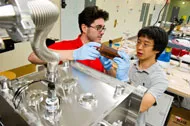
Nicholas Dou '12 (right) and his postdoctoral fellow advisor Ryan Enright discuss improvements to a cold plate that Dou has created to test condensation behavior and heat transfer properties of nanostructured surfaces. Using such novel surfaces, Dou aims to improve the performance of condensers, thereby increasing the efficiency of solar collectors.
Undergraduate Energy Research: Fueled by Team Approach
Justin Knight
Last spring, while in the thick of problem sets and finals, Nicholas Dou ’12 began gearing up for a summer of challenging research in one of MIT’s innovative energy laboratories. He was among 29 students whose work was sponsored by the MIT Energy Initiative (MITEI), which in 2011 marked its fourth year of supporting summer undergraduate research opportunities (UROPs). Dou’s participation placed him among the 85% of MIT students who take advantage of UROPs -- experiences that can dramatically enhance undergraduate education.
For Dou, whose project involved testing improvements for condensers used in solar collectors, the experience proved both immersive and rewarding. Whether sourcing equipment from vendors, modeling thermal resistance, pressures and temperatures, or ensuring the accuracy of sensors, Dou felt “very involved and invested in the entire process.” While he had previously undertaken research at MIT, Dou had never before helped design an experiment. “This time was different, because I wasn’t just hopping on and having someone tell me exactly what to do,” he says. He found this taste of responsibility and independence “exciting and motivating.”
The benefits of a UROP flow both ways. Dou’s supervisors, Evelyn Wang, Associate Professor of Mechanical Engineering, and postdoctoral fellow Ryan Enright describe the typical MIT student as diligent, smart, and creative, with a terrific work ethic. “They often come up with ingenious solutions to problems a lot of us haven’t thought about, and they contribute significantly to the larger project,” says Wang. Dou proved no exception to the rule. According to Enright, “You only have to give Nick the big picture and the resources to get it done, and he’ll do it.” Dou had initiated a relationship with the lab earlier in the school year, and as a result, says Enright, “got in on ground level.” During the summer, Dou swiftly transitioned from design-oriented tasks and modeling to “thinking in depth about what we’re trying to achieve,” and acquired a significant degree of autonomy in the lab, says Enright.
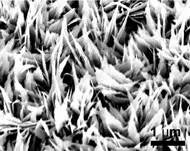
Dou’s study of novel, nano-sized structures to improve the performance of solar collector condensers may not yield immediate breakthroughs, but the research serves as a building block for scientists seeking to achieve greater energy efficiency in a variety of technologies. Andrew Cockerill, manager of university relations for BP, which financed Dou’s summer UROP through MITEI, says that “Nick’s research on nanostructured surfaces is much more broadly applicable to heat transfer questions that touch many industries.…If it yields new scientific insights about reducing energy loss, the research could have quite large impacts.” Although BP, a founding member of MITEI, underwrites some very large projects at MIT, it also supports smaller research ventures in order to “keep an eye on what’s happening in the entire MIT ecosystem,” says Cockerill. “Companies like ours are interested in scanning for new thinking and ideas among faculty, graduate and undergraduate students. This is a way, with a relatively light touch, of meeting people, and supporting a talent pipeline.”
To Evelyn Wang, the UROP can serve as an essential piece of this pipeline. “It exposes students to state of the art research they don’t get, even in lab classes,” says Wang. “It opens their eyes to something unique. We excite them in that way, so they consider research as a profession.”
Dou, a rising senior with a double major in mechanical engineering and electrical engineering and computer sciences, is currently pondering whether to pursue a Ph.D. or join an energy startup. But his time in Wang’s lab has only heightened his appetite for research. Dou hopes to extend the summer work into a senior thesis, and believes that “this research experience will help me decide the right direction to take.”

