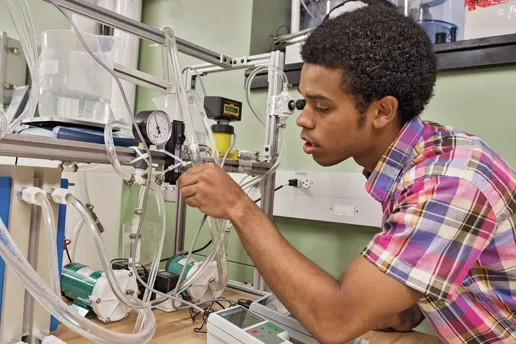
Chester Chambers ’15 of chemical engineering adjusts the flow through his electrodialysis setup, a system designed to increase the concentration of salt in a brine solution to facilitate the salt/water separation process. This approach could lead to more energy efficient, less costly methods of desalinating seawater and of disposing of saline waste streams in the oil and gas industry.
MIT undergraduates plunge into summer energy research
Justin Knight
During summer 2013, MIT Energy Initiative members and donors supported the work of 43 undergraduate students on energy-related Undergraduate Research Opportunities Program (UROP) projects spanning a wide range of topics. Funders include Founding Member BP; Sustaining Members Chevron, Lockheed Martin, Schlumberger, and United Technologies Corporation; the Tata Center for Technology and Design; and individual Affiliate members with a particular interest in supporting undergraduate research.
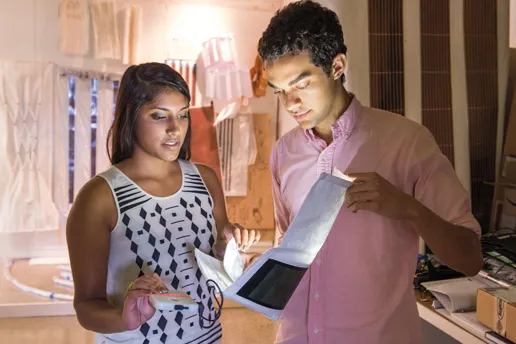
Viveka Mishra ’14 of mechanical engineering (left) and Carlos Greaves ’13 of electrical engineering and computer science demonstrate their Portable Light device in which photovoltaics embedded in flexible textiles can power an onboard lamp or charge USB-compatible cell phones. Such textile-based energy-harvesting devices can deliver power to regions of the developing world where people have no access to a power grid. Photo: Justin Knight